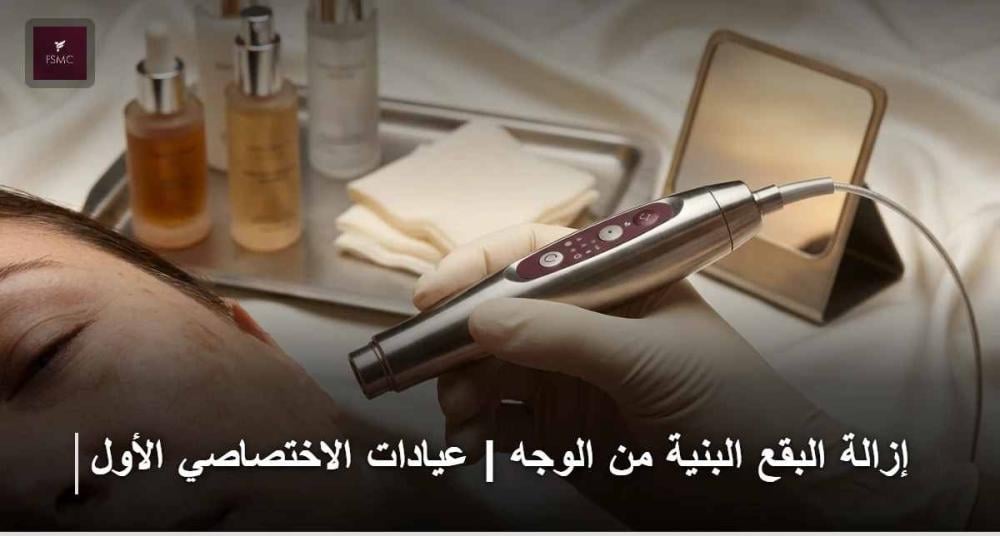
Removing brown spots from the face is a concern for many people, whether they suffer from spots that appeared suddenly after summer or others that have accumulated over the years. These spots are not just a simple cosmetic detail; they may be a sign of skin changes that warrant serious attention.
At the First Specialist Medical Clinics, the dermatology team deals with these cases daily, and the doctors are fully aware that every skin condition is unique. For this very reason, the right solution doesn't begin with a cream from the pharmacy, but rather with an accurate diagnosis from a specialist.
What are brown spots?
Brown spots are small to medium-sized areas of skin that are darker than the surrounding skin, ranging in shade from light to dark brown. The underlying cause is melanin, the natural pigment responsible for skin color, which is produced in excess in a specific area.
What's striking here is that these spots don't discriminate based on age or skin type. They appear in young people and the elderly, in those with fair skin and those with dark skin, although the way they appear and their severity vary from person to person.
People often overlook the fact that brown spots are not all of the same type. Some are superficial, affecting only the outer layers of the skin, while others are deeper and extend to the dermis. This difference determines the difficulty and duration of treatment.
What are the causes of dark spots on the face?
The causes of facial pigmentation are numerous and not always the same, which is precisely why accurate diagnosis is crucial. In fact, sun exposure is the most common cause, as the skin responds to ultraviolet rays by producing extra melanin as a natural defense mechanism, and over time, this excess accumulates in specific areas.
Hormonal changes are another significant factor. Pregnancy, birth control pills, and thyroid disorders all make the skin more prone to irregular pigment production. This explains why many women complain of spots that appear suddenly without any changes to their skincare routine.
Aging:
- With age, the cells responsible for distributing melanin lose their ability to function regularly.
- Body pigmentation resulting from sun exposure accumulates over many years and usually begins to appear clearly after the age of forty.
- Skin cell renewal slows down, making spots slower to disappear naturally.
- The skin becomes thinner, so the spots appear more noticeable even if their color doesn't actually change.
Skin diseases
- Melasma is a skin condition linked to hormonal and genetic factors, causing symmetrical dark patches.
- Recurrent eczema may leave behind brown spots after each flare-up.
- Severe acne leaves behind dark scars known as post-inflammatory hyperpigmentation.
- Some autoimmune diseases directly affect the distribution of melanin in the skin.
pharmaceutical
- Some antibiotics increase skin sensitivity to the sun and accelerate the appearance of spots.
- Chemotherapy drugs have a direct effect on skin cells and sometimes cause extensive pigmentation.
- Nonsteroidal anti-inflammatory drugs (NSAIDs), when used for extended periods, may affect skin color.
- Some blood pressure medications make the skin more prone to pigmentation when exposed to sunlight.
What types of dark spots can appear on the face?
Before discussing solutions, it's essential to understand the different types of skin blemishes that can appear on the face. This distinction isn't a medical luxury; it's fundamental to proper treatment, as each type requires its own specific protocol.
melasma
- Symmetrical dark spots often appear on the cheeks, forehead, and upper lip.
- It is linked to hormonal changes and worsens with sun exposure.
- More common in women of reproductive age
- His treatment requires patience and a comprehensive medical protocol.
sunspots
- They appear in areas directly exposed to the sun, such as the face, hands, and shoulders.
- Typically flat and with relatively well-defined edges
- It is one of the most common forms of body pigmentation after the age of fifty.
- The response to treatment is good when the correct plan is followed.
moles
- Skin growths resulting from the accumulation of melanin cells at a single point
- Most are completely benign, but regular monitoring is necessary.
- It is advisable to check it if its shape, size, or color changes.
- Removing them requires medical intervention, not home remedies.
melanoma
- A spot or bump that changes shape and color at an abnormally rapid rate
- The edges are irregular, and the color is often uneven.
- Early detection literally saves lives. Don't delay a medical visit if you have any suspicions.
- It cannot be diagnosed at home under any circumstances.
The best natural ways to remove brown spots from the face
Removing brown spots from the face naturally is possible in cases of mild and superficial pigmentation, but these methods should complement medical care, not replace it. Have you tried home remedies for months without results? These methods only make a real difference when used correctly and consistently.
- Diluted lemon juice compresses: Lemons contain citric acid which slows down melanin production, but it must be diluted well and the sun should be avoided immediately after use.
- Oatmeal and honey mask: It is a gentle exfoliant that helps to renew surface skin cells and gives the skin hydration that supports the natural regeneration process.
- Fresh aloe vera leaf: It contains the compound aloin, which has been shown to inhibit melanin production, and is applied directly to the spot at night.
- Turmeric powder with milk: A mixture with antioxidant properties, used as a weekly mask and its effect is noticed after weeks of regular use.
- Diluted apple cider vinegar: Balances the skin's pH and helps lighten surface spots, but its use requires regularity and patience.
- Green tea extract: Rich in antioxidants that protect the skin from damage that deepens pigmentation and makes it harder to treat.
- Applying sunscreen daily: Not a treatment in the literal sense, but it is the most important step to prevent any existing spot from worsening and to counteract any treatment that is not accompanied by regular use of sunscreen.
Tips for preventing brown spots on the face
- Apply sunscreen with an SPF of at least 30 every morning, even on cloudy days. UV rays do not stop with the clouds.
- Avoid direct sun exposure between 10 a.m. and 3 p.m. as much as possible.
- Wear a wide-brimmed hat when going out during peak solar times.
- Add antioxidants to your morning skincare routine, such as a vitamin C serum that works in conjunction with sunscreen.
- Do not squeeze or touch pimples with unclean fingers. This simple behavior creates dark spots that last for months.
- Keep your skin well-hydrated; dry skin is more prone to negative reactions to external factors.
- See a dermatologist regularly, especially if you have a family history of pigmentation or have used medications that affect the skin.
How long does it take for results?
This is a question everyone asks when starting a treatment for pigmentation, and the honest answer is that it depends on the depth and type of the spot and the treatment chosen. Superficial spots caused by sun exposure may respond within six to eight weeks of regular treatment with topical medications, while deep melasma may require six months or more of a comprehensive treatment plan.
The truth everyone should know is that consistency is more important than the treatment itself. Those who use the treatment intermittently will get intermittent results, and those who stop using sunscreen halfway through will find the spots return faster than they were removed. Treatment is a journey that requires a clear plan and ongoing medical follow-up.
Results from medical techniques such as laser and chemical peeling may be much faster, but they require careful evaluation by a specialist doctor who will decide which is suitable for your skin type and degree of pigmentation specifically.
Frequently asked questions about removing brown spots from the face
Are brown spots on the face dangerous?
Most brown spots are completely benign and pose no health risk, often resulting from sun exposure or hormonal changes. However, some spots can be a sign of skin conditions that require medical attention, such as skin ulcers or rapid changes in the shape and color of a mole. The golden rule: If a spot changes or causes any concern, a medical visit is the first and most appropriate step.
Is it possible to permanently remove brown spots from the face?
Permanently removing brown spots from the face is possible in many cases, especially with modern medical techniques such as fractional laser and deep chemical peels. However, some types of pigmentation, such as melasma related to hormones, require ongoing maintenance to prevent recurrence. The key is accurate diagnosis first, followed by choosing the appropriate treatment plan based on the type of spot and the skin type.
When should you see a doctor because of dark spots?
A visit to a dermatologist becomes necessary if a new spot appears that changes rapidly, or if the spot has irregular borders and multiple colors. It's also essential if the spot causes itching, bleeding, or abnormal peeling. The causes of facial pigmentation can be quite simple or require immediate medical intervention, and there's no way to distinguish between the two except through a thorough medical examination.
Removing brown spots from the face isn't a death sentence, nor is it a magic formula in a cream you bought at the pharmacy. It's a conscious decision to give your skin what it deserves: an accurate diagnosis and a treatment plan based on a true understanding of your skin type. At First Specialist Medical Clinics, our dermatology department includes specialists who give each case the attention it deserves, from the initial diagnosis to the final follow-up session. Don't delay any longer. Contact us today and begin your journey to clearer, more confident skin.